


Organized by the Populus Committee as part of the 2022 Riparian Symposium
June 28, 2022
2:00-3:00
Pacific Time (US and Canada)
How To Attend:
You are invited to a Zoom meeting.
When: Jun 28, 2022 02:00-3:00 PM Pacific Time (US and Canada)
Register in advance for this meeting:
https://zoom.us/meeting/register/tJMld-6gqjIoH9WO-jTZ87Xxvx7umfF7ZkMH
After registering, you will receive a confirmation email containing information about joining the meeting.
Streambank Bioengineering Webinar #3:
Toe and Bank Zone Treatments
This is part three of a series on streambank soil bioengineering, which functions as a starter kit for planting and restoration techniques that utilize live plant materials to achieve desired stream function.
In this webinar, Chris and Julie will briefly review the riparian planting zones, and will outline treatments that are appropriate for the toe and bank zones. This focus area was selected based on feedback after webinar #2 in this series.
Participants are encouraged to view the previous webinars at the following links prior to participating, if possible:
Principles of Streambank Bioengineering, Webinar #1
Species Selection and Collection, Webinar #2
Streambank soil bioengineering treatments to be discussed:
- Fascines
- Coir logs
- Containerized clumps
- Bulrush clumps (wildlings)
- Shrub/Tree Revetment
- Vertical Bundles
- Brush Mattress
- Wattles
- Live Beaver Dam Analogs
This session will build upon the principles discussed in the first and second webinars; however, all are welcome to join. Previous webinars have discussed:
- Strategies for selecting site-appropriate riparian species
- Techniques for locating, harvesting, collecting, and processing native plant materials
- Plant selections for streambank zones
- Plants used for various bioengineering treatments
- Propagation techniques for the collected materials to produce the highest establishment rates
Webinar Presenters:
Chris Hoag, Riparian Ecologist – Hoag Riparian and Wetland Restoration LLC
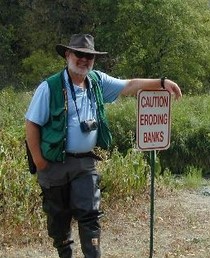
Chris Hoag has been working on riparian and wetland systems for over 40 years and is the author of over 120 technical papers on applied planting techniques for riparian and wetland ecosystems. He has been working with Streambank Soil Bioengineering techniques for 37 years and has developed two practical field manuals on bioengineering and over 100 papers describing these techniques, how to install them, materials needed, matching riparian species with appropriate streambank zones, and management after installation. Chris was formerly the project lead of the Interagency Riparian/Wetland Plant Development Project, USDA NRCS Plant Materials Center in Aberdeen, Idaho.
Chris retired at the end of 2009 and opened up a small consulting business. He has worked, taught, and consulted all over the US, Canada, Mexico, and made two trips to Afghanistan to provide technical assistance to the Afghan Ministry of Forestry and Range. He is currently collaborating with Julie Vanderwal to consolidate his years of experience, data, photos, and documentation of techniques, in order to make lessons learned accessible to practitioners.
Julie Vanderwal, Horticulture Teacher and Restoration Consultant
 Julie Vanderwal has worked at the intersection of environmental science and education for over 20 years. She graduated from the British Columbia Institute of Technology in environmental technology and from Barstow College in child development/ education. Julie has taught in outdoor and ecological education and public school contexts, working with all ages in Southern British Columbia, Northern California, South Eastern Quebec, and North Central Washington. She worked for a decade as Conservation Coordinator for the Okanogan Highlands Alliance, coordinating education and restoration programs. As part of that work, she led riparian planting in a system dominated by reed canarygrass and managed BDA-based restoration that successfully aggraded a deeply incised streambed. The team’s evolution of the BDA weaving technique inspired her to pursue hybridizing BDA methods with established bioengineering treatments, which led her to collaboration with Chris Hoag on other projects. While managing noxious weeds for stream and wetland restoration projects, as well as at her home in the Okanogan Highlands, Julie has explored non-herbicide methods of re-establishing diverse native plant communities in wetlands, mixed conifer montane forest, and shrub-steppe environments. She currently teaches Greenhouse Management and coordinates Work-Based Learning for the Oroville Jr/Sr High School in Okanogan County, and is excited to be involving students in stream restoration on a deeper level.